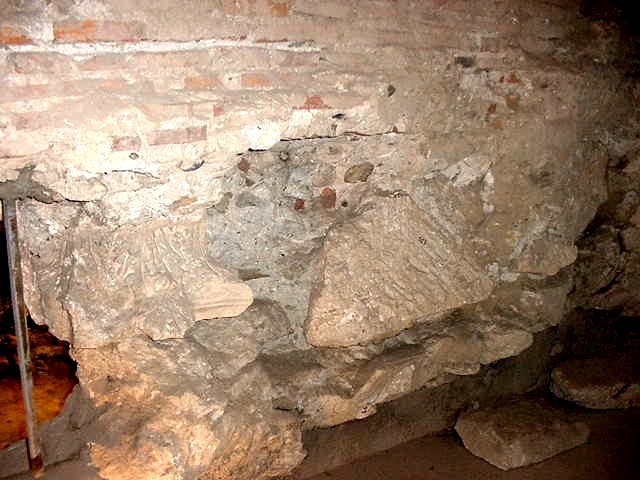
In this picture of the base of the Roman wall in Toulouse, we can see the miscellaneous rubble, such as the apparent column decoration, that was used to create the wall hastily.
Institut Catholique. Toulouse, France.
Walls
In 30 A.D. Rome granted permission to Tolosa to build city walls. These were only for prestige and intimidation initially. The walls in Tolosa surrounded the city on three sides. Around 280 A.D., walls were needed for fortification against the frequent uprising of local tribes, the Galois, and attacks from local barbarians. Since the city was only surrounded on three sides, the fourth was hastily constructed: the base was dumped with any sort of debris. Archaeologists found statues and other makeshift debris in the base of the wall.
First the Romans dug a base of 1.5 meters. Then they built the rest with stones,
leveling them out every so often with a layer of bricks. This technique was used
to stabilize the walls. Another feature they made was a buttress sticking out of
the wall on the inside every 3 meters to strengthen it against battering rams.
The Romans also strategically made every fourth tower horseshoe shaped. These
towers stuck out further than the others. Tactical building decisions of the
Romans were usually to make the wall perimeter square. However, this was not the
case in Tolosa because the city was built on a varied relief near marshes and
next to the river Garonne.
These facts show the general motives and methods in which walls were created
based on the requirements needed for the specific city. In this sense roman
walls cannot be labeled or categorized. Each city wall had its own unique
purpose and was built in reflection to what was either desired or needed.
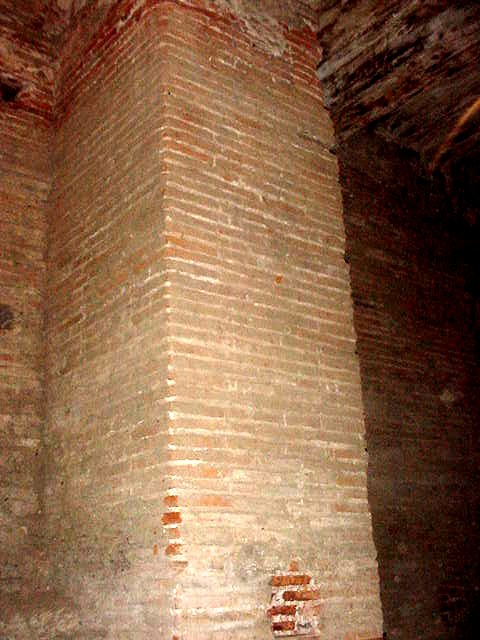
This is a picture of the remains of the wall in Toulouse. In this picture we can see one of the buttresses.
Institut Catholique. Toulouse, France.