Home        Year 7 Year 8 Year 9 IGCSE IB
 
Forums
Video
News Archive
Results
Projects
Articles
Author
 

Laptop Classroom - Student Websites as Learning Portfolios 

Websites as 'one-off' projects
 
The obvious place to start getting students building websites is with short discrete projects that may only take a lesson or two. This website about Population was produced by a student in Y8 (12-13 years old) and was her first attempt at building a website. It makes an interesting comparison with these Industrial Revolution websites produced by the same group of students six months later
Websites and group work 
One of the common misconceptions about laptop classrooms is that technology tends to encourage more individualistic learning activities. In fact the research suggests that the opposite is true. This website project on the French Revolution was produced by a small team of Y9 (13-14 years old) students as their first website project in our first year as a laptop school. More recently the same group of students worked on websites to examine the cultural successes of Weimar Germany.
Student Humanities website

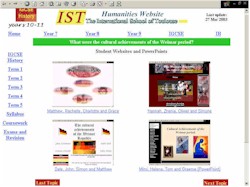
If students learn largely through an electronic medium, the obvious way for them to organise their work is through a hypertext portfolio. We encourage students to build a Humanities portal site as a means of storing and linking all their electronic learning. This is an example from a student currently in Year 9. When uploaded to a web server, this becomes a safe, portable and easily accessible portfolio of student learning. This 'multiple-intelligence portfolio' allows for a  far more flexible and therefore authentic expression of student learning than was ever imaginable within the confines of an exercise book full of handwritten exercises. 

Students as producers: Websites as platforms

Perhaps the most obvious function of a student website is to give the student a wider audience for their work. By providing students with a platform, they cease to be passive consumers of education and instead become active producers.  Recent research carried out at the United States National Learning Lab in Maine suggests that this is the most effective way for young people to learn. (see John Simkin - 'Most teachers use methods that are fairly ineffective!') Occasionally, student websites can result in original content being produced that might be of genuine use to a wider learning community. (see for example work produced by IB Humanities students at the IST on Roman Toulouse, Mozart, John Rae and the cartoons of David Low)

For further thoughts about the radical implications of learning websites in education see Richard Jones-Nerzic - The Laptop Revolution


Humanities Home